Must-have mustards:
One of the plants I chose to try on my rock outcrop was Western wallflower, Erysimum capitatum (v. capitatum), a lovely biennial species frequently seen on rocky banks, ledges, road cuts, openings in woodland and chaparral, etc. Often, after fires or other disturbances that open up and expose rock or soil, this plant can appear prolifically, sometimes by the hundreds.
One of the plants I chose to try on my rock outcrop was Western wallflower, Erysimum capitatum (v. capitatum), a lovely biennial species frequently seen on rocky banks, ledges, road cuts, openings in woodland and chaparral, etc. Often, after fires or other disturbances that open up and expose rock or soil, this plant can appear prolifically, sometimes by the hundreds.

Western wallflower just starting to flower in February. Eventually the primary spike elongates, often to 3'. In most situations the side branches will also elongate and flower, though in stressful sites usually only the primary spike flowers.
I had been wanting to try this native wildflower for several years, but I also wanted to grow the race that naturally occurs in the Garnett Creek drainage, this is the creek that drains through our property here in Calistoga CA. But I had only seen it occurring naturally in one spot and only one plant, on a rock bluff about a half mile up the canyon. Last spring I explored another nearby rock outcrop and found a few more and made a point of returning to collect 3 siliques (seed capsules); each plant might have 20 - 50 siliques if medium-sized.

A loose grouping of wallflowers on my rock outcrop in March. They provided a wonderful bright wand of color during the damp and often dreary days of "winter" here. The bluish lilac heads in the picture are the native blue-dicks, Dichelostemma capitatum, pre-existing at this site.

Grown off of rock, in "regular" soil - here being a heavy clay - Western wallflower typically produces a bushier plant with many side branches, thus creating a mound of flowers. This can also be induced by pinching the primary "leader" during its vegetative phase. Sometimes browsing rabbits may do this for you..
We were fortunate last fall to have a substantial rainfall in mid October which thoroughly moistened the ground including my rock outcrop. I used this opportunity to plant out the rather small seedling plants into various crevices, niches, ledges, etc. on the outcrop. Although we didn't have follow up rains for several weeks after that, I watered down the areas with new seedlings regularly so that they did not dry out - as young seedlings are wont to do if not watered, usually with tragic results.
By the time the rains returned in November, the seedlings were already quite well established, and subsequent rains kept them growing quickly. A little fertilizer around each rosette helped them turn into small plants by December. Being mustards, wallflowers thrive during the cool season, getting bigger as the days got colder and shorter.

Early flowering wallflowers and juvenile rosettes (rosette above right of big flower head). The rosettes of wallflowers are formed from many long narrow leaves, each leaf having shallow drawn-out lobes on the sides - these scattered teeth and lobes give an extra visual appeal to the foliage mound .
In nature, wallflowers germinate soon after the first rains and grow through the winter/spring into rosettes, which then sit out the long dry season until the next seasons' rains revives them and prompts them to flower the second spring. By starting them early and getting them to grow before the New Year into little rosettes, when the days lengthened, they "thought" that they were already a year old. Thus during January I was thrilled to see most starting to elongate into flowering stems - the "trick" had worked. Of the nearly 75 seedlings planted out, nearly 68 flowered (5 had died), thus the biennial had been turned into an annual.
Apart from growing them in your garden which is quite easy since they are readily available (Annies Annuals, etc.), our Western wallflower is always an attractive plant to come across in the wild. This species, Erysimum capitatum, is the most widespread in the state, occurring in many sites at many elevations. The color too varies considerably, and previously some of the color variants were considered species or subspecies but are now lumped together. The most widespread color is a deep golden orange, but some are more pure orange, others more yellow, others even cream. For example, the plants native to the Calistoga area are slightly more golden than those at The Cedars 40 miles to the W, where they are more orange.

Western wallflower at The Cedars in Sonoma Co. in March. Wallflowers are excellent at attracting butterflies to the springtime garden.
Evalyn's Touch.
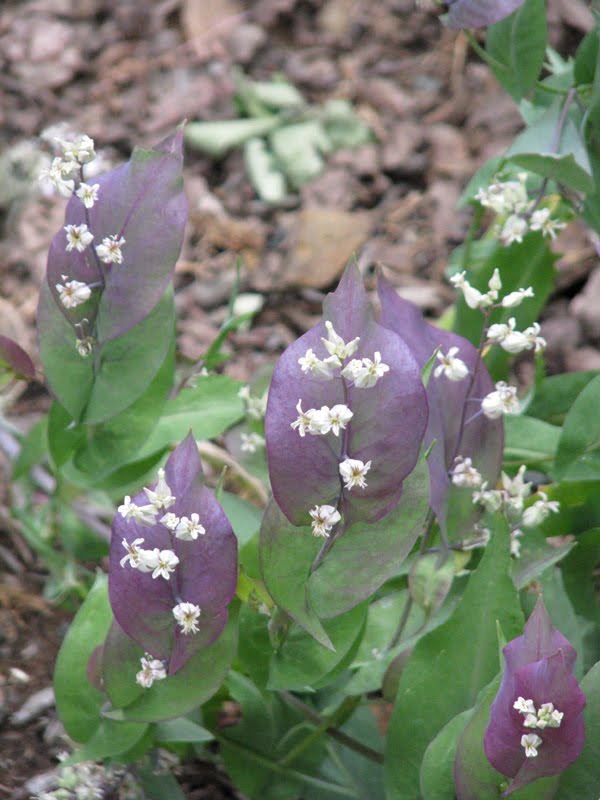
If you want to add an annual to your garden that no-one has ever seen before, one that will amaze you every time you see it, try the Farnsworth jewelflower, Streptanthus farnsworthianus. Native to the southern Sierra Nevada foothills it is named for a 20th century rancher and amateur botanist/naturalist, the late Evalyn Farnsworth of Porterville, Tulare Co. Like most jewelflowers it grows on sterile, stony or rocky places, especially "balds" and ledges.
I was first given a 4" pot of this annual (actually two separate friends gave me one each - I guess my penchant for weird plants is well known) about 4 years ago; it was being grown - and still is - again by Annies Annuals of Richmond CA, a source for many unusual plants in our area (she ships too).

While the wallflowers were flowering in Feb. through April, the seedlings of the Farnsworth jewelfower were growing discretely, having self-sown for 4 years now on this rock face. By May, they were producing their curious "flowers", actually spikes of flowers set off by huge purplish/metallic blue bracts. While hard to see in this overall view, there are many in the central area of this picture.
Having moved to Calistoga the previous year, I immediately thought that I should try this native treasure on my new rock outcrop. They did excellently, and when they went to seed, I crushed it up and sprinkled around to a wider area. The next season they returned in good numbers, and I've enjoyed this plant ever since.

Sometimes called Evalyn's jewelfower, this remarkable annual displays its bright white true flowers against a very unusual expanded bract of rose purple overlaid with a strange bluish color that reflects the light.

Our native jewelflowers (genus Streptanthus) are numerous and all seem to have developed odd features - growth form (branching), foliage modifications, flowers and even seed capsules (siliques). But Evalyn Farnsworth really hit upon one of the weirdest. But it isn't simply weird, it is quite lovely, Dr. Seuss would have loved it.


While the stems and true flowers are small, it is the purple-blue bracts that stand out from a distance, creating a wonderful color accent in the garden.
I have over the last 30 years tried to grow many of California's fascinating jewelflowers, but most have been very difficult and frustrating in cultivation; especially if you want to keep them for more than one season. Last winter I tried growing seed of the bristly jewelflower from across the canyon, but it - while germinating quickly and easily - grew stunted and distorted as the plants enlarged.

What you see is not what you get. Similar to some other jewelflowers, the juvenile plants give no indication of its future. As a young plant the leaves are finely divided, with almost thread-like divisions. In mid-life, it has a "crisis" and changes its appearance entirely, the ferny foliage of youth becomes large clasping heart-shaped leaves which then produce the even larger purple colored bracts below the flowers. This plant is in transitions showing the two types of foliage.
Thus it is surprising to me that the Farnsworth jewelflower does so well. I'm sure the rock outcrop helps, but it doesn't seem to be bothered by disease, mildew or aphids like some of my other attempts with other species.

Mass of Evalyn's jewelflower on rock face. These have self-sown into the rock crevices - a hard place for any plant to grow. The colored bracts provide an excellent accent to the silver and grays of Dudleya, Santolina chamaecyparissus, Senecio talinoides 'Jolly Gray', and trailing Salvia sonomensis. Below, Athanasia acerosa, a shrub with yarrow-like flower heads and lilac-pink rose.

Autumn in June. As the plants matures and begins to dry out the clasping foliage turns soft colors of lilac, bronze, peach, salmon, yellow and chartreuse. The purple bracts look even more interesting at this phase.

Not your ordinary garden annual, both the form and color of this jewelfower creates exceptional interest. I have not tried this, but if it could be dried with these colors, it would make a unique dried "flower" arrangement.

A cloak of many colors giving its farewell to spring, time to segue to another season.


