Showing posts with label Planet Horticulture. Show all posts

Wednesday, December 8, 2010

New Home Garden for Planet Horticulture

Forestville, Sonoma Co., CA


Gardens, like hope, spring eternal for those who are passionate about plants.
In mid-September 2010, we moved to Forestville in Sonoma Co. and immediately set out to create a new garden.
We cleared away the previous landscape as it had little interest for us, leaving only the paved back patio, raised vegetable bed and 7 plants.

View S from the downstairs, showing cleared back yard on September 17th.


Same view late December 2010.  This part of the garden is now essentially complete and waiting for warm weather to return for new growth. This part was relatively instantaneous, as most of the plants were in containers, and essentially were re-arranged in their new home.

SE corner of the back garden after clearing, mid September 2010.  The purple leaf plum, two Red Flame grapes and a crepe myrtle were left from the original landscape.


Same view as above in late December 2010.  As in the earlier pictures, the planted urns edge the pavement, but beyond, most of the plants are in the ground.  The largest urn, a tijana or olive oil jar from Portugal, creates a focal point from anywhere in the back garden.  Although it is hard to distinguish the individual plants, the plantings will form a woodland of palms, evergreen and deciduous trees and shrubs, large and small succulents with an herbaceous and bulb understory.  There is even a "secret" sitting area in the corner that a garden visitor can discover. (Note: the two sculptural urns and the chiminaria are lidded during winter to prevent them filling with water.)

Tuesday, May 25, 2010

Golden lotus banana, Musella lasiocarpa; little banana, big interest.


 Four golden lotus "flowers" in May as new leaves are just starting to emerge in my Calistoga garden.

I first heard of Musella in the mid-90's in some catalogue (can't remember the name) which mentioned its great hardiness and showed a tiny picture of its "flower".   At that time I was living and gardening at the Maybeck Cottage Garden in Berkeley CA, and I was open to trying almost anything.  I also like the look of bananas and had several growing in the garden there already. (The name Musella is a diminuative of Musa, a genus of bananas). Soon afterward, I noticed Heronswood Nursery (then in Kingston WA) had it listed in their catalogue, and since at that time I was ordering dozens of fascinating plants from that amazing place (quite different from today), I ordered one.  I have to confess I also loved the name, Musella, so soothing and mellifluous.
In the winter months after the leaves die off, a swollen "bud" emerges from the succulent trunk.
I planted my new treasure in the front bed, where the breakfast nook jutted out, and enjoyed its tropical looking foliage the first season.  Even in its first year the main stem became surrounded by many pups.  In the second season, the plant grew robustly developing a thick succulent short trunk from which 4' long elongated oval leaves were produced.  By this time the plant was a small colony of stems and leaves and provided a lovely contrast to the chusan palm, Trachycarpus wagnerianus, nearby.  But it was still entirely a foliage plant.  It wasn't until the third winter that it finally flowered.

Here in my Calistoga garden, Musella forms an excellent mass of large foliage that is highly resistant to tearing or shredding - so common in true bananas.  The large foliage, while textural in itself, provides a "shadow board" for the nearby Trachycarpus.

While this plant is touted for its winter hardiness, I have only grown it in the moderate climates of the Bay Area of California, where frosts are rare.  But even here, in winter, especially by mid December, or earlier if there is a frost, the large, strong leaves begin to deteriorate in appearance. I cut them off at this stage.  This leaves the strange club-like trunks encased in recurving dried leaf bases, which while having that "weird factor" is probably best considered the "off season".  But once the plant has a few years of establishment, these odd trunks will suddenly burgeon at the tops.  Eventually a large swollen "bud" is formed of bracts that are variously colored gold, golden orange, or reddish orange.


First season "bud" on left and second season "bud" on right.  Initially this "flower" will seem to come out of the stem top, whereas in subsequent years it will appear on top of the dried bracts of the previous seasons' "flower".  Eventually the entire stem will die.

From my experience both in Berkeley and Calistoga, this budding can occur nearly any winter month, but is inevitable by spring.  As the outer bracts of this "bud" curl back, an interior of dozens of golden bracts condensed into a fat artichoke-like structure is revealed .  These continue to curl back, eventually forming the "lotus-like" head that is strangely beautiful with its cone-like center with a glowing tip, and golden orange reflexed bracts.


 Three true flowers can be seen poking out of the base of the bracts as they reflex.

The "true" flowers are actually small tubular flowers on the inside base of each bract.  They are the same color as the bracts, and are partially hidden unless you look directly inside the head.  They are extremely popular with hummingbirds in my garden suggesting that there is a reward inside each tube.  The humming birds will often sit on the reflexed bracts and delicately sip out of the rows of tubular flowers.  For some reason this sight always reminds me of a comparative wine tasting.


 Two close ups of the foliage showing the pronounced textural quality of the leaves which are slightly folded with a strong central rib running the length and a herring-bone pattern of the lateral veins - more pronounced below than above.


 The color(s) of the "lotus" have a wonderful radiant quality, even during dreary wet weather, the glowing heads almost appear to float in the landscape, reinforcing the appropriateness of its common name.  On those days with glowing skies at sunset or dawn, the heads almost seem on fire.
A second season "flower" showing both the lovely spiral arrangement of the bracts and the glowing golden color that seem radiant in early or late light.


This closer view of the Musella foliage shows the rippled leaf surface, adding a pleasant visual richness to the leaf.  The ability for shadows to play on the leaf is another plus.

Gradually, as spring moves into summer, the leaves will once again re-appear and gradually "swallow up" the golden louts heads, masking them unless you have the curiosity to pry apart the leaves.  But from my observations it seems like the flowering stops altogether.  And while the floral heads are what may attract the plant enthusiast, the foliage mass is not to be disparaged.  In many ways it is most similar to the bird-of paradise plant, Strelitzia reginae, but with bigger bolder leaves, more like the giant bird-of-paradise, S. nicolai, but not quite as large and never developing the tall trunk that species will develop.  The biggest plus is that the leaves are very tough, seldom ripping or shredding which is so common on the big Strelitzia and most bananas.  My biggest plant in the Calistoga garden gets the full brunt of near-hurricane force winds during our many ferocious wind storms - storms that often last more than a day.  These are storms that can defoliate some plants  - but not the Musella.  Not that these leaves are completely tear proof, but they are tough.


 By the second season after flowering, the flower head and stem finishes its life cycle.  On the left the smaller head is above the previous season's dried bracts.  On the right, flowering has ceased and large, pea-sized black seeds burst out of their enclosures.

While I have read that this plant grows best with routine water and good drainage, and I'm sure the plant would love these conditions, my reality has been of heavy soils and drought stress.  Yet my plants look great.  And better than that, the foliage shows almost no stress even on the hottest days - often in the low hundreds (F) here, while almost everything else in the garden looks wilted and distressed.  I think the fleshy root mass probably accounts for this ability to deal with so much heat, providing water even when there isn't any in the surrounding soil.

 A garden view of Musella in May on a rainy day where the flower heads suggest torches.

Fortunately for us here in the Bay Area of CA, this once obscure plant is no longer hard to find in the retail nursery trade.  So for those who have a tickling for the tropical, let us lotus, the golden lotus that is.

Whether in sun or overcast, the plant in f lower is radiant; a wonderful addition to any garden.


Monday, May 10, 2010

On the Rocks; gardening on a rock outcrop. Part 1


The rocky bank as I first saw it before we purchased the property.  Here it is covered in dry weedy grasses, thistles, etc.  There are two separate terraces above the stone-inlaid concrete walls, with garage, small house (roof) and water tanks behind them.

A habitat that has always fascinated me is the rock outcrop.  Rock plants are frequently different than the prevailing plant community, thus represent a sort of island of unusual beings.  The conditions of growing on rocks often creates plants of atypical form or expressions, odd appearances and features.  And plants growing on rocks tend to display themselves dramatically and with flair.
Part natural, part exposed rock bank along driveway just after moving in.  A few pots, ceramic pig, pipes and metal sculptures temporarily set against hillside awaiting decision on future placement. The lower of two concrete retaining walls can be seen at top.

Because of my attraction to rock outcrops, I have often envied yards that had exposed rock. One could construct a rock outcrop, but that is a lot of work. And unless you are very good with rocks, it is often unsatisfactory, especially compared with nature.
So I was rather thrilled when we bought our property in Calistoga 5 years ago and it had considerable rock around the houses. I speculate that originally the site was probably an impressive rock outcrop that mostly got leveled to build the two houses, garage and two driveways.  However fragments persisted and some areas were actually created by excavation, which exposed the subsurface rock.


The rock bank after first rains showing new growth. predominantly weeds.  Two Yucca and a 'Santa Rita' opuntia (cactus w pinkish pads) and the pre-existing purple fountain grass (Pennisetum) are the only plantings in Nov 05. (The little shed is a pump house).

While the horticulturist may crave rocks, rocks don't crave horticulture; the simple truth is that it is really hard to grow plants on rocks.  On this bank the top had something like soil in spots, a colluvium of clay and rock rubble, but other sections are mostly rock and rubble.  The four native blue oak - Quercus douglasii - were obviously going to have priority of resources, especially water once the heat arrives.  There were three other native plants growing there; the perennial Phacelia heterophylla, the summer dormant bulb, soap plant, Chlorogalum pomeridianum, and another bulb (corm) called blue dicks, Dichelostemma capitatum.

 By the spring of 2006 more planting had taken place, especially at the base of the bank where good soil had been brought in to grow a more traditional mix of horticultural material such as roses, Cape reed, Chondropetalum tectorum, shrub milkwort, Polygala dalmasiana, 'Purple Haze' honeyplant, woodland beschorneria, etc. etc. etc.  The idea was to make the approach to the main house more exuberant, but not to hide the rock face.  Most of the growth on top of the rock are the pre-existing natives; phacelia and soap plant.

The rock outcrop here was always intended to be naturalistic with an overlay of horticultural experimentation.  Seen mostly in passing while driving or walking along the driveway, it was not intended to be a precious "rock garden" of choice alpine treasures or minute bun plants.  That is another form of horticulture altogether,  generally more suited to a place where the exquisite details of those types of plants can be more fully appreciated.

 By the spring of 2008 both the bottom "mixed border" planting as well as the rock planting itself had grown in a bit, although the plants on the rocks were quite slow.  Thus there is not much that stands out in this picture except the Yucca 'Blue Boy' below the wall and the Yucca aloeifolia 'Marginata' above the wall.  However all the native-to-site plants were thriving, and the diversity of plants was much greater than might appear.  On the rocks were shrubby Senecio, many Agave species and cultivars, Dudleya and Echeveria, Pachyveria, Salvia sonomensis and S. brandegei, Aloe species, Trachycarpus wagnerianus, Eriogonum umbellatum, Xanthorrhoea preissii, Watsonia X's, Amaryllis belladonna, Amarcrinum, Aeonium, Puya, etc.  Also another native annual, Phacelia distans had moved in on its own.

The summer months were very hard on the rock plantings as they received very little water, some none, and they are subjected to many hours of intense sun and heat almost every day for 6 months.  The plantings at the bottom did receive more regular irrigation, thus were able to "cover" for the drier background planting.  While many gardeners consider the winter as the "off season", here it is the opposite, with summer being the dormant time of year.  In spite of this, some plants did retain good appearance, particularly the Yucca, Opuntia and the shrub Senecio - which are particularly impressive in their drought tolerance (there are two green plume-like small  Senecio shrubs below the wall, one on the left and one in the middle, both near oak trunks.)
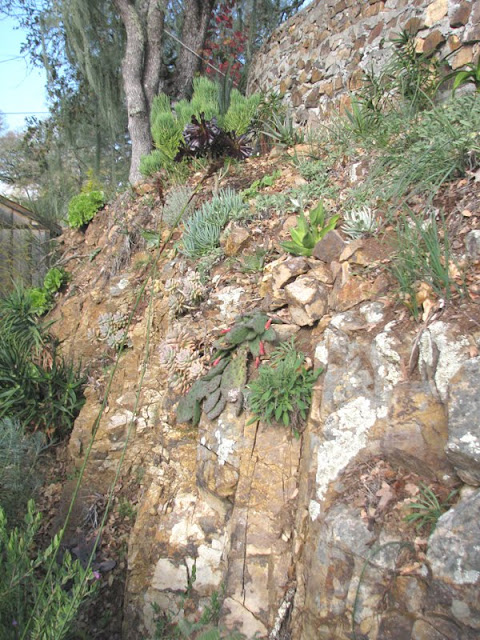


By November most of the plants are in full re-hydration and starting to grow again.  This is the same pattern as one would find in nature in this area.  However a "trick" I developed while taking care of the CA native collection when I was at the UC Botanical Garden (1978 - 2002) was to extend the season by starting to water in October if the rains didn't appear on their own - this activates the new growth so when the rains do materialize, the plants are set up to utilize the moisture more rapidly.  (While the philosophy of "celebrating dormancy" is valid in a dry climate, after 6 months, the celebration gets kind of tiring. Time to celebrate rejuvenation.)

This is a close up detail of the center of the rock area showing several Agave, Dudleya, Pachyveria, and the trailing Opuntia compressa. (Opuntia compressa, native to the central and eastern North American continent especially on sand dunes along the coast and Great Lakes, is a lovely cactus of great hardiness.  It is best displayed cascading down a slope.  However, while its lack of large spines makes it look "friendly" for a cactus, the tiny and numerous glochid spines - barely visible - can be insidious and irritating if handled without good gloves).

By late January the rock plants are in full growth, with an Aloe arborescens Variegata in flower.  The two green shrub Senecio, mentioned above, are especially attractive in the winter light.  The low gray ground cover on the top center of the bank is the native sage, Salvia sonomensis, native to the volcanic ridges not far from the property. It, and the native bulb called blue dicks, while not obvious in this picture, are already in flower. 
 
 View of rocky bank planting in April 2010.  Spring is definitely the peak season here, though some of these will look good into the early summer; particularly the mixed shrub plantings at the base which get routine irrigation.  The numerous yellow flowered scapes projecting from the upper rocks are the native wallflower, Erysimum capitatum, grown from seed obtained in the canyon.  Blue dicks, Dichelostemma capitatum, are numerous on the upper slopes, but not as visible in this picture - yet are showy in real life.

Part II will feature more detailed portraits of a few select plants from this rocky site.

Thursday, June 11, 2009

Silverado Brewery beer garden

It may seem to some that read my blogs (and previously my emailings) that my primary occupation is observing plants in the wild; this unfortunately is not the truth. Designing landscapes and gardens with my partner, David McCrory, is my actual profession. There are a number of common threads in the two activities based on perception and the implications of a given site. But one is concerned with observing what is there and the other is about creating what someone will observe.
We recently completed a project in the Napa Valley just N of St. Helena, located at a historical stone building now housing a micro-brewery and restaurant. The restaurant has a outdoor eating and drinking area in front of the building but separated from busy Rt. 29 by an old, low stone wall. The outdoor space is dominated by a huge valley oak (Quercus lobata).
One of the problems with the site is that the brewery building is connected to a whole series of other buildings that form a complex, with multiple parking lots and many different entrances, thus it is confusing where one should go if one wants a beer or meal.

The entry we first encountered was a wide gravel road off of the parking lot. Although the outdoor picnic tables were evident, it was unclear if this was the main entrance or a service entry.

To improve the perception of this as the main entrance the proprietor had a wide, yet narrower concrete walkway poured to lead to the front door (in the center of the facade). Another improvement was removing a strip of asphalt to separate the parking area from the building, which while creating some strange-shaped gaps, did make it clear that one should not drive up the walkway.

We took his concrete walk several steps further. First the concrete was stained with iron sulphate to give a warm rust color that picked up on the brownish red of the stone facade. A ranch-style gate frame was built to give the parking area an obvious entrance directing traffic to the front door. A sign saying Silverado Brewery will hang from the top piece, re-affirming that this is indeed the path to the brewery. We also extended the planting along the walkway to make the first part of the passage more of garden experience.

(above) Entry walk and beer garden tables before.

Same view after new planting.

A view inside the gate. The plantings along the entry walk were part previous plantings, but edited and supplemented with many new items. We used a number of edible shrub/trees such as black mission fig (on left), Santa Rosa weeping plum, two citrus and many herbs that could be harvested for the restaurant. Golden leafed hops were used repeatedly as vines.

One plant we featured, although it is currently not conspicuous in the pictures are 8 golden leafed Robinia 'Frisia', a type of black locust. These were used outside the skirt of the large valley oak, to provide summer shade for the outdoor tables, as sitting in the sun when the temperature is 85 degrees (F) or greater - a common occurrence in the summer here - is unbearable.

I first became enamoured with the Frisia golden locust nearly 3 decades ago when I saw them at Western Hills Nursery in Occidental CA in Sonoma Co. The golden-hued light that streamed through the lacy foliage reminded me of autumn under a Norway maple "back East" where I grew up. However with Frisia, you have that golden light from leaf break in early May through October when the leaflets fall. Unlike many golden-leafed trees, this one does not turn green a month after leafing out, nor does one have to wait until fall, as with some trees. Other pluses this tree has is it is deciduous, thus the welcome winter sun will not be blocked, it is quite drought tolerant, it grows quickly, takes pruning well, and does not sucker from the roots as do some locust, and rarely sets seeds. But it is the radiant glowing golden light that really sets this tree apart. Some diners and/or drinkers, will probably feel like they are reaching that pleasant euphoric glow that good food and beer can create.

While nearly all the plantings have flowers, we did not want to create a flowery effect, as the owner wanted the beer garden to have a masculine feel. Thus the plantings are meant more for foliar effects and to create separation and shade. We also emphasized the edible potential by using many vegetables - at least as temporary fillers as the more permanent elements grow in. Corn, squash, tomatoes, etc., along with the herbs and fruit trees, should give the garden a practical, casual, grounded feel quite different from the fluffy yet stiff formal landscapes you see everywhere else in the valley around wineries.

On axis with the main walk we placed a large beer barrel made into a recirculating fountain, both as a focal point while walking to the main door, and to provide visual and audible pleasure of water. The main door is to the right of this picture and not seen. The doorway behind the fountain is not used by the public but allows a view into the beer making section of the building.

A view from the N end of the building before showing the recent concrete walkway to the front doors, and the parking lot in the distance. In this picture the nearer door (where the concrete walk meets the asphalt walk) is used primarily as a service entrance and as a view into the brewery section of the building, and is not used by the public as an entrance.
Same view afterward. The odd asphalt section was removed and turned into a foundation planting bed, as is the next strip against the building. The half wine barrels were removed. Most of the beer garden space is to the right of this view, and is not substantially changed except for the over-story golden locust trees added to provide shade. After all, the primary need of a beer garden/outdoor eating space is space and flexibility for good food and good beer. Though it is also nice to find the front door.

Thursday, June 4, 2009

Weeping flowers; a nod to the pendulous flowered California buckeye

California buckeye, Aesculus californica, is a much loved native tree. I tried to convey my affection for this versatile deciduous small tree in a recent article in Pacific Horticulture magazine (Vol. 70, #1, Jan - Mar 2009) which was illustrated with Phil Van Soelen's excellent photos.
Each May and June as I drive around the North Bay counties, I revel in the gorgeous floral display found along nearly any road and even within many towns and cities. Since my brain always focuses on variation in the wild, I've become intrigued by the various ways the long flower trusses are produced, their size, length, width, color and angle of display.
Most commonly the flower clusters are up and outward-facing, giving an exuberant, almost celebratory character to the round-headed trees or shrubs. Some trees have a range of angles, usually the upper flowers being erect, the side branches being horizontal and the lower branches angled downward, creating a radial look.
A small number of trees have predominantly nodding or pendant flower spikes. This character seems especially well expressed in the Napa Valley and the picturesque town of St. Helena seems to be the epicenter of this rather rare trait. These floral waterfalls are - in my opinion, stunningly beautiful, and it is odd that so little is ever mentioned concerning them.
Here is one just south of town (St. Helena) on Charter Oak Dr. growing along the margins of a small creek.
Not far away, this tree graces the picnic grounds of Taylor's Refresher, a popular local drive-in eatery.
Just west of town, this beauty is on Spring Mt. Rd. just before it heads into the hills, making a wonderful statement at a road junction.
This is the above tree (closer) showing the densely packed flower spikes - a lovely swoop of fat fragrant flowers.
Unfortunately, California buckeye does not root easily, so clonal propagation of these forms is restricted to grafting. I've tried collecting seed from some of my favorite plants, but the character is probably recessive, as the only ones to flower so far (after 5 years) are erect flowering.
Just N of town on Rt. 29 this festive tree always brings a smile to my face, such prolific beauty for free and without work.

If there were a contest for most pendant, this tree above the bus stop on the main street in town near Pine Street would certainly win. Although it tries to grace the bus shelter, the clutter of the street sadly detracts from its beauty - in a park it would be a feature plant. Close up of the nearly vertically descending trusses - much like a wisteria - of the bus stop beauty.

As the buckeye might say, "There's not just one way to flower; just do it beautifully!"

Followers